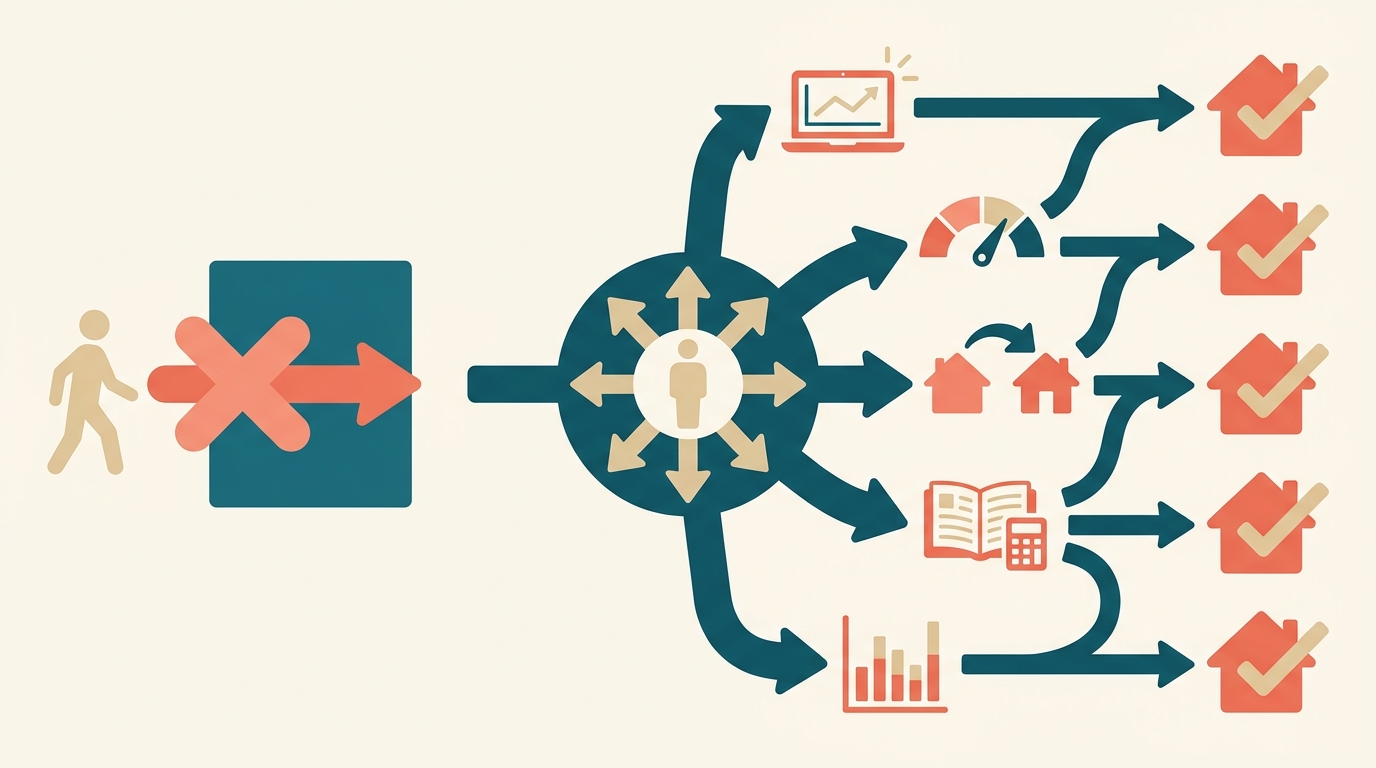
If your file is complicated — self-employed income, a recent bankruptcy, a short job history, foreign national status, or a Florida property with insurance headaches — you can still get approved for a home loan in Tampa in 2026. The mechanism is simple: an independent mortgage broker shops your file across a wide network of wholesale lenders, each with its own underwriting rulebook, until your situation matches a program that will say yes. A retail bank runs your file against one rulebook. A broker runs it against dozens.
Why does a Tampa mortgage broker approve complicated loans a bank can't?
A broker isn't the lender — the broker is a shopper. Bay to Bay Lending operates as a mortgage broker that shops a wide network of lenders on behalf of borrowers, which means your file can be submitted to the wholesale investor whose guidelines actually fit your situation, rather than forced through a single bank's narrow box. That structural access is why self-employed, credit-event, and non-standard borrowers often land where a retail bank already declined.
Under the hood, every wholesale lender publishes a different matrix: minimum credit score, acceptable income documentation, reserve requirements, property-type overlays, and how they treat items like bankruptcy seasoning or asset depletion. A banker only knows their own matrix. A broker reads yours against many of them at once.
What counts as a "complicated" borrower in Tampa in 2026?
A complicated file is any file that doesn't fit a vanilla W-2, 20%-down, clean-credit, single-family profile. In Tampa that commonly means self-employed or 1099 income, recent credit events like bankruptcy or foreclosure, variable or interrupted income, foreign national or ITIN status, investment properties, or standard borrowers buying a non-standard property (older roof, flood zone, condo with insurance issues).
Tampa's own labor and housing data show why this is a bigger slice of buyers now. The metro added roughly 8,600 jobs in the year through July 2026 but unemployment rose to 4.8% from 4.1%, which translates to more interrupted W-2 histories and more borrowers rebuilding after a job change — the kind of file that benefits from broker shopping rather than a single bank's overlay.
How does the broker fit a self-employed or variable-income file to a lender?
Self-employed borrowers in Tampa are usually placed on either a conventional loan with two years of tax returns, a bank statement program that uses 12–24 months of business deposits in lieu of returns, a profit-and-loss program, or an asset-depletion program. These are non-QM programs — meaning they live outside the Qualified Mortgage safe harbor — and are widely available in Florida through wholesale lenders that specialize in self-employed income.
Each program reads income differently. One lender may hit you with a 50% expense factor on bank-statement deposits; another will use your CPA's letter. The broker's job is to know which program will actually underwrite the way your business runs, before your file goes out — not after a decline.
Can you get a mortgage in Tampa after a bankruptcy or foreclosure?
Yes, under defined waiting periods. For FHA loans, a Chapter 7 bankruptcy does not disqualify a borrower if at least two years have elapsed since the discharge date at the time of FHA case number assignment. A shorter window — not less than 12 months — may be acceptable if the bankruptcy was caused by documented extenuating circumstances beyond the borrower's control.
For a Chapter 13, FHA requires at least 12 months of satisfactory pay-out performance and written permission from the bankruptcy court to enter the mortgage transaction. On the foreclosure side, federal rules require servicers to wait at least 120 days of delinquency before initiating foreclosure, and Florida's judicial process adds state-specific timelines on top; that matters because the dates on your credit report drive your seasoning clock.
What about non-citizen, ITIN, and foreign national buyers?
Non-citizen buyers routinely close purchases in Tampa. Permanent residents are typically treated like U.S. citizens on agency loans. Non-permanent residents with valid work authorization usually qualify for FHA or conventional financing with standard documentation. ITIN borrowers and true foreign nationals are placed on non-QM investor programs that price for the added documentation and often require larger down payments and reserves.
None of this is exotic — it's just a different lender's rulebook. Because Bay to Bay Lending operates as a mortgage broker that shops a wide network of lenders, we can route a foreign national buying in Hyde Park or a snowbird purchasing in Westshore to the wholesale investor whose program is built for that profile.
How does Florida property risk factor into approval?
In Tampa, the property can block the loan independently of the borrower. Flood zone status, windstorm exposure, roof condition, and insurability must be established early — a four-point inspection or an uninsurable roof can kill a file after you're already under contract. Hurricane and heavy-rain seasons can also delay appraisals and inspections and trigger extra lender scrutiny of wind mitigation and water intrusion.
This is where neighborhood matters as much as credit. Closed-sale medians vary sharply across Tampa ZIP codes — roughly $259,999 in ZIP 33605 versus about $529,000 in ZIP 33626 over a recent six-month window — meaning loan amount, program limits, and down payment math differ meaningfully by block. The property-risk review runs in parallel with the credit review, and both have to clear.
What does the Tampa market look like for a complex buyer right now?
Market conditions in 2026 favor the complicated borrower more than they have in years. According to ibuyer.com reporting, Tampa Bay's median sale price (Redfin) in mid-2026 was approximately $443,000, and the Zillow average home value was approximately $380,000. Homes averaged 45 to 64 days on market, months of supply ran 5.4 to 6.5 months, and the sale-to-list ratio sat near 98% — all buyer-friendly signals. Active listings were up 14.8% to 25% year-over-year.
What that means for a non-standard file: you have time to gather documentation, order a wind mitigation report, and negotiate seller concessions such as a rate buy-down. It does not mean lenders have relaxed their underwriting standards.
Program fit by borrower scenario
| Borrower scenario | Typical program routes | Key documentation |
|---|---|---|
| Self-employed, strong deposits | Bank statement loan, P&L loan | 12–24 months business statements |
| Chapter 7 BK, 2+ years past discharge | FHA, conventional after full seasoning | Discharge papers, re-established credit |
| Chapter 13, 12+ months of payments | FHA with trustee/court approval | Court permission letter, payment history |
| Foreign national / ITIN | Non-QM investor program | Passport, visa, foreign bank statements, reserves |
| High-asset, low-income retiree | Asset depletion / asset qualifier | Statements for liquid assets |
| Investor with multiple properties | DSCR loan | Lease, rent schedule, property cash flow |
What does a Tampa broker actually do that moves your file forward?
Beyond shopping, the broker structures the file so it survives underwriting the first time. Bay to Bay Lending uses in-house processing to keep underwriting and appraisal moving efficiently, and pre-approval can often be completed the same day once basic information and documentation are provided. For complicated files that speed matters, because a week of back-and-forth on income documentation is a week your contract clock is burning.
Experience is a real underwriting input. Bay to Bay Lending's team has a combined lending experience of more than 32 years, and the firm has more than 20 years in the mortgage lending business and holds NMLS number 4102 — Florida mortgage broker and originator licensing is governed by Chapter 494, Florida Statutes, and is verifiable through the OFR and NMLS.
From Bay to Bay Lending: Opening new credit, financing furniture or a car, or changing jobs while they’re under contract. Moving cash around without a paper trail causes problems too. Another one is shopping for homes before getting pre-approved and then falling for something they can’t qualify for.
DJ, Jay, and Jessica were all amazing to work with. We had a not so easy file that we worked together to get to the finish line. Having a lender that truly cared and wanted the best for their client was the key to getting this one closed.Kathryn PlouffeSr. Escrow OfficerPropy Title & Escrow
Frequently asked questions
Does getting denied by a bank hurt my chances with a broker?
No. A bank's decline is tied to that bank's single rulebook, and brokers submit to different wholesale lenders with different guidelines. A borrower turned down at a retail bank for self-employed income or a past credit event is routinely approved through a non-QM or portfolio program the bank didn't offer. The credit inquiries don't disappear, but the decline itself doesn't travel with the file.
How long after a Chapter 7 bankruptcy can I get an FHA loan in Florida?
For FHA loans, a Chapter 7 bankruptcy does not disqualify a borrower if at least two years have elapsed since the discharge date at the time of FHA case number assignment. A shorter period of not less than 12 months may be acceptable if the bankruptcy was caused by documented extenuating circumstances beyond your control. Conventional and non-QM loans have their own, often longer, seasoning rules.
Can self-employed buyers in Tampa qualify without two years of tax returns?
Yes. Bank statement loans use 12 to 24 months of business or personal deposits to calculate income instead of tax returns, and profit-and-loss programs use a CPA-prepared statement. These are non-QM programs — meaning they sit outside the Qualified Mortgage safe harbor — and are widely available in Florida through wholesale lenders that specialize in self-employed borrowers. Pricing is generally higher than agency loans but qualification is more flexible.
Will a Tampa flood zone or roof issue stop my loan?
It can, independently of your credit. Lenders require evidence the property is insurable, which in Florida means confirming flood zone status, windstorm coverage, and roof condition — often through a four-point inspection and wind mitigation report. An uninsurable roof or an unavailable flood policy can block closing even on a perfect borrower file, so insurability should be checked before you remove the inspection contingency.
Can non-citizens buy a home in Tampa?
Yes. Permanent residents are generally treated as U.S. citizens for mortgage purposes. Non-permanent residents with valid work authorization typically qualify for FHA or conventional loans. ITIN borrowers and true foreign nationals are placed on non-QM investor programs that usually require larger down payments and documented reserves, but these loans close regularly in the Tampa market and don't require Social Security eligibility.
How long does a complicated mortgage approval take in Tampa right now?
With market months of supply at 5.4 to 6.5 and homes averaging 45 to 64 days on market in mid-2026, buyers have more negotiating room than during the 2026 peak. A straightforward file can close in roughly 30 days once under contract; complicated files commonly run 30 to 45 days depending on documentation, condo review, insurance binding, and whether an appraisal or inspection is delayed by weather.
The takeaway
Complicated doesn't mean unqualified — it means your file needs to meet the right lender, not every lender. The structural advantage of a Tampa mortgage broker is simple: more rulebooks, more programs, more ways to say yes on a file a single bank already closed. If you want this handled professionally in Tampa, you can reach Bay to Bay Lending at (813) 251-2700 or https://baytobaylending.com to start a conversation and see which program actually fits your situation.