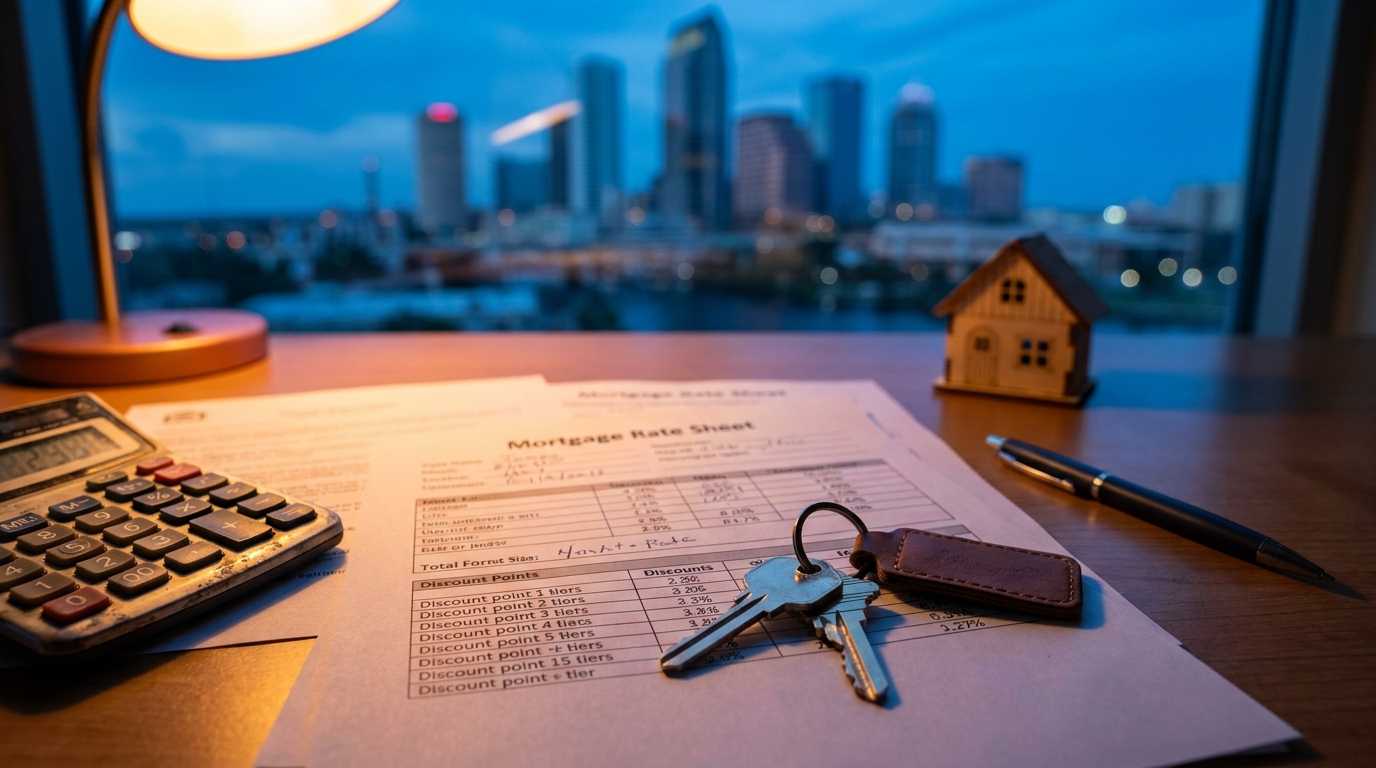
To lower your mortgage rate in Tampa right now, you have four practical levers: buy discount points at closing, improve your credit profile before you lock, restructure the loan term or product, or refinance an existing mortgage. On a $400,000 loan in Tampa, buying 2.625 points ($10,500 upfront) can drop a 30-year fixed rate from roughly 7.000% par down to 6.375% — a real reduction, but one that only pays off if you stay in the loan long enough to earn back the cost.
Every week you wait, two things move against you: rates can drift higher, and the payment you're stuck with keeps compounding. The point of this guide is to help you decide which lever to pull, and when pulling it stops making sense.
What's the fastest way to reduce a mortgage rate in Tampa, FL?
The fastest way is to buy discount points at closing. In Tampa, one point costs 1% of the loan amount and typically shaves 0.125–0.25 percentage points off your rate. On a $400,000 loan, 0.250 points ($1,000) drops a 30-year fixed from about 7.000% to 6.875%, saving roughly $33 a month. It's an immediate, contractual rate cut — no waiting on markets.
Points scale. Current Tampa pricing on a $400k conventional 30-year fixed runs from a par rate of 7.000% (zero points) down to 6.375% for 2.625 points, or $10,500 upfront. The tradeoff is cash today versus a lower payment for the life of the loan. At Bay to Bay Lending we run the break-even math both ways before we recommend a structure — because the right answer depends on how long you actually plan to keep the loan.
How much do discount points cost on a Tampa home loan in 2026?
On a $400,000 Tampa mortgage, discount points cost $4,000 each (1% of the loan) and reduce your rate in tiers. Mild buy-downs run $1,000–$3,000 for a rate in the mid-to-high 6% range. Aggressive buy-downs of $8,500–$10,500 can push a 30-year fixed to 6.500% or 6.375%. Costs scale directly with loan size — a $300k loan cuts every figure by a quarter.
| Structure (30-yr fixed, $400k) | Points | Upfront cost | Rate | Est. P&I |
|---|---|---|---|---|
| Lender credit | -0.625 | -$2,500 (credit to you) | 7.125% | $2,695 |
| Par rate | 0 | $0 | 7.000% | $2,661 |
| Mild buy-down | 0.250 | $1,000 | 6.875% | $2,628 |
| Moderate buy-down | 0.750 | $3,000 | 6.750% | $2,594 |
| Aggressive buy-down | 1.500 | $6,000 | 6.625% | $2,561 |
| Maximum buy-down | 2.125 | $8,500 | 6.500% | $2,528 |
| Deep buy-down | 2.625 | $10,500 | 6.375% | $2,495 |
The break-even test is simple: divide upfront cost by monthly savings. The deep buy-down saves $166/month versus par — meaning $10,500 ÷ $166 ≈ 63 months to earn back, so running the break-even math against your expected time in the loan is essential before committing. Stay past that and you profit. Sell or refi before then, and points were the wrong move.
Can improving my credit score lower my Tampa mortgage rate?
Yes — often more than points can, and for free. Lenders price rates in credit tiers, and moving from a 700 FICO to a 760+ tier can shave 0.25% to 0.5% off your rate on the same loan. Tampa Bay's conventional 30-year fixed range currently spans roughly 6.24% to 6.90% depending on credit, LTV, and points paid.
Fast wins: pay revolving balances below 30% utilization, dispute errors, and avoid new credit inquiries in the 90 days before you apply. Waiting six weeks to clean up a credit report can move you into a better pricing bucket permanently. That's the cost-of-waiting argument in reverse — sometimes a short, deliberate delay is the highest-ROI move you'll make.
Should I restructure the loan itself to get a lower rate?
Restructuring the loan — shortening the term, changing the product, or adjusting the down payment — can lower your rate meaningfully. In Tampa, a 15-year fixed prices at 6.500% par versus 7.000% on a 30-year, and a 20-year fixed sits at 6.875%. Larger down payments that push you below 80% LTV also drop the rate and eliminate PMI.
The catch is payment size. That 15-year at 6.500% costs about $3,484/month on a $400k loan — $823 more than the 30-year par payment. For buyers in higher-cost pockets like South Tampa or Westshore, the shorter term isn't always feasible. An ARM or a temporary buy-down (2-1 or 3-2-1) can be a middle path for borrowers who expect income growth or plan to move within five to seven years.
Is refinancing to a lower rate worth it in Tampa right now?
Refinancing is worth it in Tampa when the new rate is at least 0.5–0.75% below your current one AND you'll stay in the home past the break-even point. Current 30-year refi rates sit in the mid-to-high 6% range nationally (roughly 6.78–6.86%), with Freddie Mac's early-September 2026 read at 6.71%. Closing costs run 2–6% of the loan amount — $6,000 to $18,000 on a $300k loan.
Do the math before you commit. If refinancing a $300k loan costs $9,000 (a mid-range estimate) and saves you $200/month, break-even is 45 months. Sell the house in Seminole Heights or Carrollwood before then and you've lost money to fees. Some Tampa lenders — including Bay to Bay Lending — offer lender-credit structures that reduce or eliminate out-of-pocket closing costs in exchange for a modestly higher rate, which can flip the math for shorter horizons.
What does waiting actually cost a Tampa borrower?
Waiting costs money in two ways: the payment you're overpaying every month, and the risk that rates rise before you act. On a $400k loan, the difference between a 7.000% par rate and a 6.500% buy-down is $133/month. Wait six months to act and that's roughly $800 of savings you'll never recover — plus the risk that market rates move against you.
Florida-specific timing matters too. Insurance premiums in Tampa continue to climb, and lenders factor escrow into qualifying ratios. A borrower who qualifies comfortably today at current insurance quotes may qualify more tightly six months from now — meaning waiting can shrink the loan amount you're approved for, independent of what rates do. Hillsborough County recording fees and Florida documentary stamp taxes also add to closing costs and don't decrease over time.
When is waiting actually the right call?
Waiting makes sense in three cases: you're within 60–90 days of a meaningful credit-score jump, you don't yet have the cash reserves to cover closing costs plus a healthy emergency fund, or your job or income situation is genuinely unsettled. In those cases, locking a rate today buys you a worse loan than a short, deliberate delay would produce.
Waiting does NOT make sense as a way to time the market. Nobody — not economists, not lenders, not the Fed — reliably predicts short-term rate moves. If the loan works at today's rate and today's payment, the math almost always favors acting.
Frequently asked questions
How much does one discount point lower my rate in Tampa?
One discount point in Tampa typically lowers your interest rate by 0.125 to 0.25 percentage points, and costs 1% of the loan amount. On a $400,000 loan, that's $4,000 per point. The exact rate reduction depends on the lender, loan program, and current market conditions — some tiers offer better per-point value than others, which is why it's worth reviewing the full rate sheet.
What credit score do I need for the lowest mortgage rates in Tampa?
The lowest Tampa mortgage rates generally go to borrowers with FICO scores of 760 or higher, combined with a loan-to-value ratio at or below 80%. Scores between 720 and 759 still qualify for competitive pricing but usually pay 0.125% to 0.25% more. Below 700, rate adjustments become more significant, and below 660 you may be limited to FHA or non-conventional products with different pricing structures.
How much are refinance closing costs on a Tampa mortgage?
Refinance closing costs in Tampa typically run 2% to 6% of the loan amount, or roughly $6,000 to $18,000 on a $300,000 loan. Costs include lender fees, title insurance, appraisal, Florida documentary stamp taxes, and Hillsborough County recording fees. Some lenders offer no-closing-cost refinances, which usually work by rolling costs into the rate rather than waiving them outright.
Is a 15-year mortgage really cheaper than a 30-year in Tampa?
A 15-year mortgage carries a lower interest rate — currently around 6.500% par in Tampa versus 7.000% on a 30-year — but the monthly payment is substantially higher. On a $400,000 loan, the 15-year runs about $3,484 per month compared to $2,661 for the 30-year. You save enormously on total interest, but the higher payment isn't feasible for every household budget.
Can I negotiate my mortgage rate with a Tampa lender?
Yes, mortgage rates are negotiable, especially through a broker who shops multiple wholesale lenders on your behalf. Rate sheets change daily, and different lenders price the same borrower differently based on their appetite for that loan type. Getting quotes from at least three sources — and letting each know you're comparing — routinely produces a 0.125% to 0.25% improvement over a single-lender quote.
How long does it take to refinance a mortgage in Tampa?
A standard rate-and-term refinance in Tampa typically closes in 30 to 45 days from application, though streamlined refinances on FHA or VA loans can move faster. Timing depends on appraisal turnaround, title work, and how quickly you provide documentation. Florida's title and recording requirements add a few days compared to some other states, so building in a small buffer around a rate-lock expiration is smart.
Bringing it together
Lowering your mortgage rate in Tampa isn't one decision — it's a stack of them: how much cash to put toward points, whether to invest six weeks in credit repair, whether the shorter term fits your budget, and whether refinancing pencils out against closing costs. The right combination depends on your loan size, your timeline in the home, and how much liquidity you can commit at closing.
Tampa borrowers who want a professional to walk through the tradeoffs — with the actual rate sheet, actual break-even math, and a plan that reflects your situation — can reach Bay to Bay Lending at baytobaylending.com. It's a straightforward next step for anyone weighing these decisions.