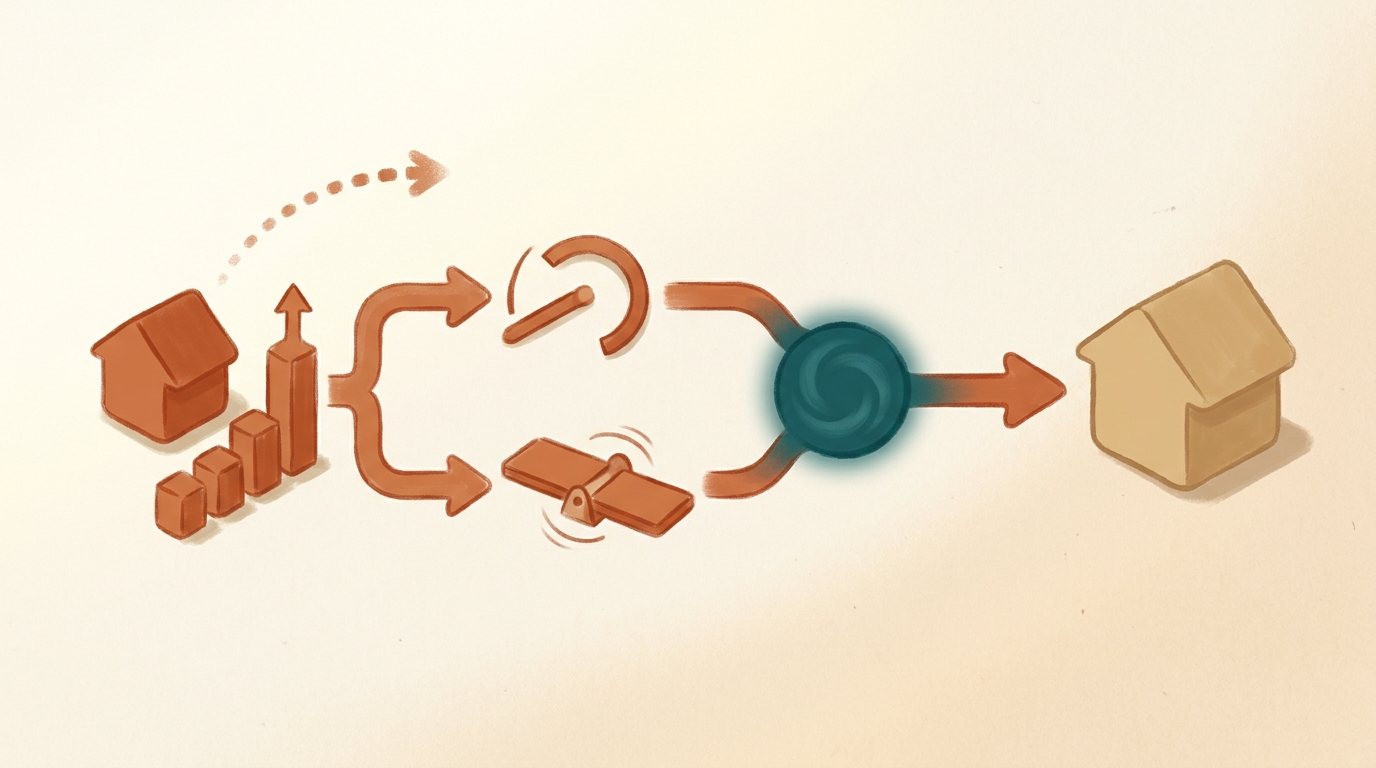
Buying a new home before selling your current one in Tampa usually comes down to one of four financing structures: a bridge loan secured by your departing home, a HELOC or home equity loan tapped before you list, a cash-out refinance, or a new purchase mortgage underwritten with both housing payments counted in your debt-to-income ratio. Which one fits depends on your equity position, your DTI headroom, and how long you can realistically carry two homes through a Tampa Bay closing cycle.
The Tampa–St. Petersburg–Clearwater metro is giving buyers a bit more breathing room than it did a year ago. As of September 2026, roughly 27.5% of listings in the metro received a price reduction. That softer backdrop makes a buy-before-sell plan more workable than it was at the peak — but it does not eliminate the risk of carrying two mortgages, two insurance policies, and two tax bills at the same time.
What does "buy before sell" actually mean in Tampa in 2026?
Buying before selling means closing on your next Tampa home while you still own and owe on your current one. You are, for a window of days or months, responsible for two sets of principal, interest, taxes, insurance, HOA dues, and utilities. The financing has to be built around that overlap, and the exit — selling the departing home — has to be realistic.
In the four-county region covering Hillsborough, Pinellas, Pasco, and Manatee, months of supply sat at 4.9 in the week of September 27, 2026, and the regional median sale price was $390,000 that same week. A 4.9-month supply means a well-priced, well-presented home can still move, but "well-priced" is doing a lot of work in that sentence. Build your plan around a slower sale than you hope for.
How do lenders qualify you when you still own your current home?
Fannie Mae's Selling Guide (B3-6-02) generally requires lenders to count BOTH housing payments — current and new — in your debt-to-income ratio when you are buying before selling, unless a specific departure-residence exception applies. That is the single biggest qualification hurdle, and it is where most buy-before-sell files either come together or fall apart.
Exceptions exist for borrowers converting the departing home to a rental, for borrowers with a fully executed sale contract that will close before the new loan, and for a handful of lender-specific overlays. Bay to Bay Lending operates as a mortgage broker that shops a wide network of lenders on behalf of borrowers, which matters here because overlays and departure-residence policies differ meaningfully from investor to investor. A file that gets declined under one lender's guidelines can be approvable under another's.
What are the main financing options for buying before selling in Tampa?
Five structures do most of the work: a bridge loan secured by the departing home, a HELOC drawn before you list, a home equity loan, a cash-out refinance of the current home, or a standard purchase mortgage that qualifies you with both payments. Each has a different cost profile, timing window, and risk if the departing home sits longer than expected.
| Option | Best when | Main risk |
|---|---|---|
| Bridge loan | You have strong equity but tight DTI | Short term; cost climbs if home doesn't sell |
| HELOC | Set up BEFORE you list | Lenders may freeze or call the line once a home is listed |
| Home equity loan | You want a fixed lump sum for down payment | Adds a monthly payment to DTI math |
| Cash-out refinance | Rates and equity both favor it | Resets your current mortgage; closing costs |
| Qualify with both payments | Income easily covers both | DTI ceiling; reserves requirement |
A HELOC is often the cheapest tool — Florida lenders typically allow borrowing up to 80–85% of a home's value minus the mortgage balance, with some credit unions offering up to 100% LTV — but any HELOC on the departing home can be frozen or called once the home is listed for sale. That is why these lines have to be opened and funded before the "For Sale" sign goes in the yard.
How does a bridge loan actually work on a Tampa purchase?
A bridge loan is a short-term loan secured by the equity in your current home, used to fund the down payment (and sometimes closing costs) on the new one. It is designed to be paid off in full when the departing home sells, usually within six to twelve months. The lender underwrites to the equity position and the exit plan, not to a 30-year amortization.
Bridge loans typically carry higher rates than conventional mortgages and have origination costs on top. They are not the right tool for every file — but when DTI is the pinch point and equity is strong, a bridge can be the difference between winning and losing a Tampa contract.
What local Tampa factors change the math?
Three Tampa realities reshape a buy-before-sell plan: flood zones, insurance costs, and the homestead reset. Any one of them can turn a workable budget into a stretched one.
Flood insurance is mandatory for structures in FEMA-designated Special Flood Hazard Areas with federally backed mortgages, and Tampa Bay has pervasive flood exposure across Hillsborough, Pinellas, Pasco, and Manatee. Even homes outside mapped high-risk zones can flood, so a current flood quote on both properties is essential before you budget carrying costs. Florida's homeowners insurance market is also expensive and underwriting-sensitive — roof age and condition can decide whether a policy is bindable at all, which in turn decides whether the loan closes.
The homestead piece is the one buyers forget. Florida's homestead exemption and Save Our Homes assessment cap apply to a qualifying primary residence and are lost on sale; the new buyer's tax bill is calculated on the post-sale assessed value, not the seller's current bill. If you are moving within South Tampa or across the bay to Pinellas, estimate the NEW tax number before you decide what you can carry.
What does the closing table actually look like?
From Bay to Bay Lending's home purchase loans team: It’s mostly signing a big stack of papers at the title company, and most of the work happens before you sit down. You get your Closing Disclosure at least three business days ahead, so the numbers shouldn’t surprise you. What does catch Florida buyers off guard is the cash to close. It includes state doc stamps and intangible tax on the mortgage, a year of homeowners insurance paid up front, and escrow reserves. Always call the title company at a number you already have to confirm wire instructions. Never trust an email.
Hurricane season (June 1–November 30) can further delay inspections, insurance binders, and closings. If your buy-before-sell window spans that stretch, build schedule flexibility into both contracts and lock insurance quotes early.
Why does the broker channel matter for this kind of file?
A buy-before-sell file is harder to place than a straightforward purchase because it depends on departure-residence policy, bridge-loan appetite, HELOC availability on a soon-to-be-listed home, and DTI treatment that varies by investor. Bay to Bay Lending's team has a combined lending experience of more than 32 years and uses in-house processing to keep underwriting and appraisal moving — both of which matter when a file has two properties, two insurance binders, and two moving timelines.
If you’re looking for a mortgage broker who is knowledgeable, responsive, and absolutely relentless in getting a deal to the finish line, look no further than DJ Rondeau and the team at Bay to Bay Lending.DJ worked with us on the sale and purchase of two historic homes—a historic 1897 home in Tampa Heights and a 1922 historic home in Seminole Heights—and expertly navigated the unique challenges that come with financing older properties, particularly with a VA loan.What impressed us most was DJ’s incredible attention to detail. He was always several steps ahead, proactively identifying potential issues before they became problems and ensuring that every piece of documentation, every deadline, and every requirement was handled correctly. His diligence saved us countless hours, prevented unnecessary stress, and kept the transaction moving smoothly from start to finish.Historic homes often come with surprises, and combining that with the additional requirements of a VA loan can create a complex transaction. DJ never missed a beat. He took the time to explain every step of the process, answered every question promptly, and made us feel confident and informed throughout the entire journey.Beyond his expertise, DJ genuinely cares about his clients. We never felt like just another loan file. He was accessible, patient, solution-oriented, and fully invested in helping our family achieve our goals. When challenges arose, he approached them with creativity, professionalism, and a calm confidence that immediately put us at ease.In an industry where communication and execution matter, DJ is truly exceptional. His knowledge, work ethic, and commitment to service are second to none.We are incredibly grateful for everything DJ and Bay to Bay Lending did to help us secure our dream home, and we would recommend him without hesitation to anyone looking for a mortgage professional who consistently goes above and beyond.
Frequently asked questions
Can I use a HELOC on my current Tampa home for the down payment on a new one?
Yes, if the HELOC is in place before you list the current home. Many lenders will freeze or call a HELOC once the collateral property is listed for sale, so timing matters. Open and, if needed, draw the line while the home is still off the market, and confirm the lender's specific policy on listed properties in writing before you rely on the funds.
Will I have to qualify with both mortgage payments?
Usually yes. Fannie Mae's Selling Guide B3-6-02 generally requires lenders to count both the current and new housing payments in your debt-to-income ratio when you are buying before selling, unless a departure-residence exception applies — such as a fully executed sale contract on the current home or converting it to a documented rental. Ask the lender upfront how they will treat both obligations.
Is a bridge loan or a HELOC cheaper for a Tampa buy-before-sell?
A HELOC is generally cheaper if you can set it up before listing, because bridge loans carry higher rates and origination costs tied to their short term. A bridge loan is often the better fit when DTI is the problem, when the HELOC window has already closed, or when the departing home needs to be shown and sold quickly without a draw sitting against it.
How long can I realistically expect to carry two homes?
Plan for several months, not several weeks. Months of supply across Hillsborough, Pinellas, Pasco, and Manatee was 4.9 months in the week of September 27, 2026, which means a well-priced listing can move but a stretched price can sit. Budget carrying costs — both mortgages, both insurance policies, taxes, HOA, utilities, and maintenance — for a slower sale than you hope for.
What happens to my homestead exemption when I sell?
Florida's homestead exemption and Save Our Homes assessment cap apply to your qualifying primary residence and are lost when that home is sold. On the new home, you must apply with your county property appraiser to establish homestead, and your tax bill will be assessed on the new purchase, not the prior owner's capped value. Estimate the new tax number before budgeting.
Does flood insurance affect my ability to close on a Tampa home?
It can. If either property sits in a FEMA-designated Special Flood Hazard Area and has a federally backed mortgage, flood insurance is generally required, and the lender needs a bindable quote before closing. Tampa Bay flood exposure is widespread across the four-county region, so get flood and homeowners quotes on both properties early — availability and premium can change what you can afford to carry.
Working with a broker on a buy-before-sell file
Buying before selling in Tampa works when the financing structure matches the file — bridge for tight DTI with strong equity, HELOC set up before listing for cost efficiency, cash-out refinance when rates and equity cooperate, or a straight purchase when income carries both payments. The wrong product on the wrong file is how a buy-before-sell plan turns into a stretched budget.
Readers in Tampa who want this handled professionally can reach Bay to Bay Lending at (813) 251-2700 or https://baytobaylending.com to walk through which structure fits their equity position, DTI, and timeline.