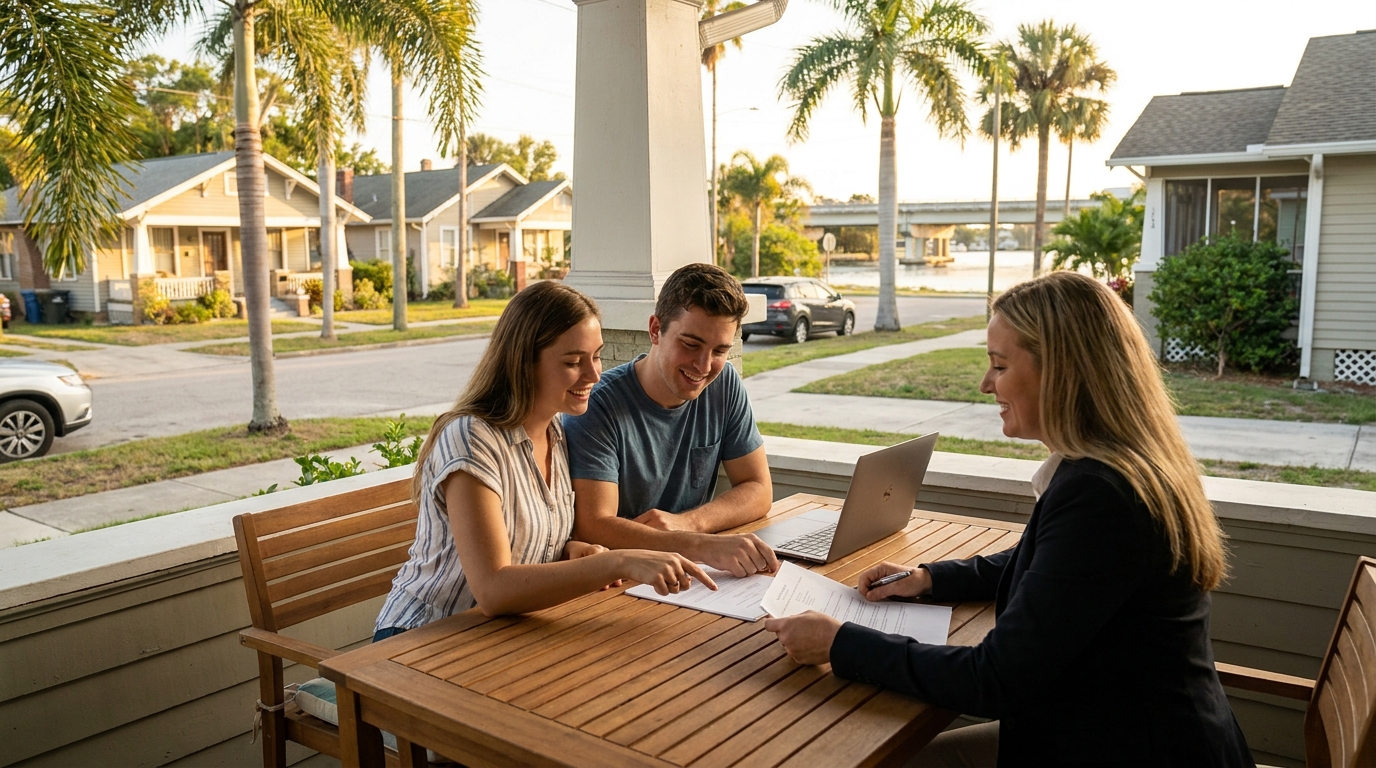
If you're buying your first home in Tampa, the choice between an FHA loan and a conventional loan usually comes down to two questions: how strong is your credit, and how much cash do you have ready to put down? The answer shapes your monthly payment, your long-term cost, and even which neighborhoods are realistically in reach.
Here's an honest breakdown of how the two programs compare for a first-time buyer in the Tampa market, without the sales gloss.
The Short Answer for Tampa First-Time Buyers
FHA loans generally work best if you have a lower credit score, smaller savings, or a higher debt load. Conventional loans usually win if you have stronger credit, more money saved, and you're focused on the lowest long-term cost.
Both are offered by private lenders, but the FHA program is insured by the Federal Housing Administration, part of HUD. Conventional loans have no government insurance and typically follow conforming rules set by Fannie Mae and Freddie Mac.
Credit Score: Where Each Loan Draws the Line
Credit is usually the first filter.
- FHA: Minimum score of 500 overall, with 580+ required for the popular 3.5% down option. Scores between 500 and 579 require 10% down.
- Conventional: Typical minimum of 620, with the best pricing usually reserved for buyers at 700–740 or higher.
In practice, Tampa lenders follow those same national standards. If your score is sitting in the 580–660 range, FHA is often the more realistic path. If you're comfortably above 700, conventional financing usually gets you a better long-term deal.
Down Payment: What Tampa Prices Actually Look Like
With a median Hillsborough County home price around $385,000, the down payment gap is meaningful.
- FHA at 3.5% down: roughly $13,475 on a median-priced Tampa home.
- Conventional at 20% down: roughly $77,000 on that same home to avoid mortgage insurance entirely.
Conventional loans do allow as little as 3% down under certain first-time buyer programs, but typical down payments still fall between 5% and 20%. If you're eyeing a townhome in Seminole Heights or a bungalow near Hyde Park, the down payment math can be the deciding factor.
Mortgage Insurance: The Long-Term Cost Difference
This is where the two loans really diverge, and it's the part first-time buyers most often miss.
FHA Mortgage Insurance Premium (MIP)
- Upfront MIP: 1.75% of the loan amount, usually rolled into the balance.
- Annual MIP: ranges from 0.15% to 0.75% of the average outstanding loan balance, with most buyers paying around 0.55% per year.
- Duration: if you put less than 10% down, MIP lasts the life of the loan. With 10% or more down, it drops off after 11 years.
Conventional Private Mortgage Insurance (PMI)
- Required when your down payment is under 20%.
- Freddie Mac estimates PMI generally runs 0.03%–0.07% of total loan value per year, though Tampa first-time buyer guidance often cites averages of 0.35%–0.65% annually.
- Duration: PMI is cancelable once your loan-to-value hits roughly 80%, either through paydown or appreciation.
The takeaway: FHA is easier to qualify for upfront, but conventional PMI is typically cheaper and, more importantly, it goes away. FHA MIP for the life of the loan is a real cost you should model before signing.
Loan Limits: What You Can Actually Borrow in Hillsborough County
Tampa is generally a standard-cost market, so conforming limits apply as they do in most of the country.
- FHA one-unit limit in Hillsborough County: published figures fall between $498,257 and $563,500 depending on the source and update date.
- FHA multi-unit limits: around $637,950 for two units, $771,125 for three, and $958,350 for four — useful if you're considering a small multi-family as a first home.
- Conventional conforming baseline: $766,550 for a one-unit property, with 2026 figures published as high as $832,750 in most areas and up to $1,249,125 in designated high-cost markets.
If you're shopping entry-level to mid-price homes in South Tampa, Brandon, or Riverview, FHA limits usually work fine. If you're stretching into higher-priced pockets closer to Bayshore or Westshore, conventional often gives you the borrowing room you need.
Debt-to-Income and Property Rules
FHA tends to be more forgiving on DTI ratios, past credit blemishes, and the use of gift funds for the down payment and closing costs. It also requires you to occupy the home as your primary residence within 60 days of closing — you cannot use FHA for a pure investment property or a vacation home.
Conventional loans are stricter on DTI but more flexible on property type. You can use conventional financing for primary homes, second homes, and investment properties, which matters if you're planning ahead for a future rental.
The Tampa-Specific Considerations
A few local realities are worth factoring in:
- Insurance and hurricane risk: Tampa's Gulf Coast climate means homeowners insurance is a bigger line item than in many other U.S. markets. Lenders will factor this into your qualifying payment, which can affect how much house you can afford under either program.
- Older housing stock: Many first-time buyer homes in neighborhoods like Seminole Heights or Old Seminole Heights are older bungalows. FHA has stricter property condition standards, so a home needing roof or system repairs may be easier to finance conventionally.
- Lender overlays: Many Tampa lenders effectively require 620+ for conventional loans even when program rules allow more flexibility. Overlays vary by lender, which is why comparing offers matters.
A Simple Decision Framework
- Check your score and savings. Under 680 with less than 5% down? FHA is likely more attainable. 700+ with 5–20% down? Conventional usually costs less over time.
- Match the loan to your price range. Well within FHA limits? Either works. Pushing above? Conventional may be necessary.
- Compare total cost, not just the down payment. Add up the 1.75% upfront MIP plus lifetime annual MIP on FHA versus conventional PMI that drops off around 20% equity.
- Think about your timeline. Planning to refinance in 5–7 years as your credit and equity improve? FHA can be a reasonable bridge. Staying long-term with good credit? Conventional usually wins.
FAQs
Can I use an FHA loan for a duplex in Tampa?
Yes, as long as you live in one of the units as your primary residence. FHA multi-unit limits in the Hillsborough area go up to roughly $637,950 for two units, which can make house hacking viable.
How much do I really need to buy my first home in Tampa?
On a median-priced home around $385,000, plan for about $13,475 for a 3.5% FHA down payment, plus closing costs, reserves, and the first year of homeowners insurance. Conventional 3%-down programs can push the down payment even lower if your credit qualifies.
Is FHA or conventional better if my credit is around 660?
At 660, you can qualify for either, but FHA often prices better at that level. Once your score is at 700 or above, conventional typically becomes the cheaper long-term option because PMI is lower and cancelable.
Does FHA MIP really last the life of the loan?
If you put down less than 10%, yes. Many Tampa buyers plan to refinance into a conventional loan once they've built equity and improved their credit, specifically to eliminate MIP.
Next Steps for Tampa First-Time Buyers
The right loan is the one that fits your credit, your savings, and how long you plan to stay in the home — not the one with the flashiest headline rate. Running the numbers side by side on both FHA and conventional, with real Tampa insurance costs baked in, is usually what settles the question.
If you'd like a professional to walk through both scenarios with your actual credit, income, and target neighborhood, Bay to Bay Lending works with first-time buyers across the Tampa market and can be reached at https://baytobaylending.com for a side-by-side comparison.