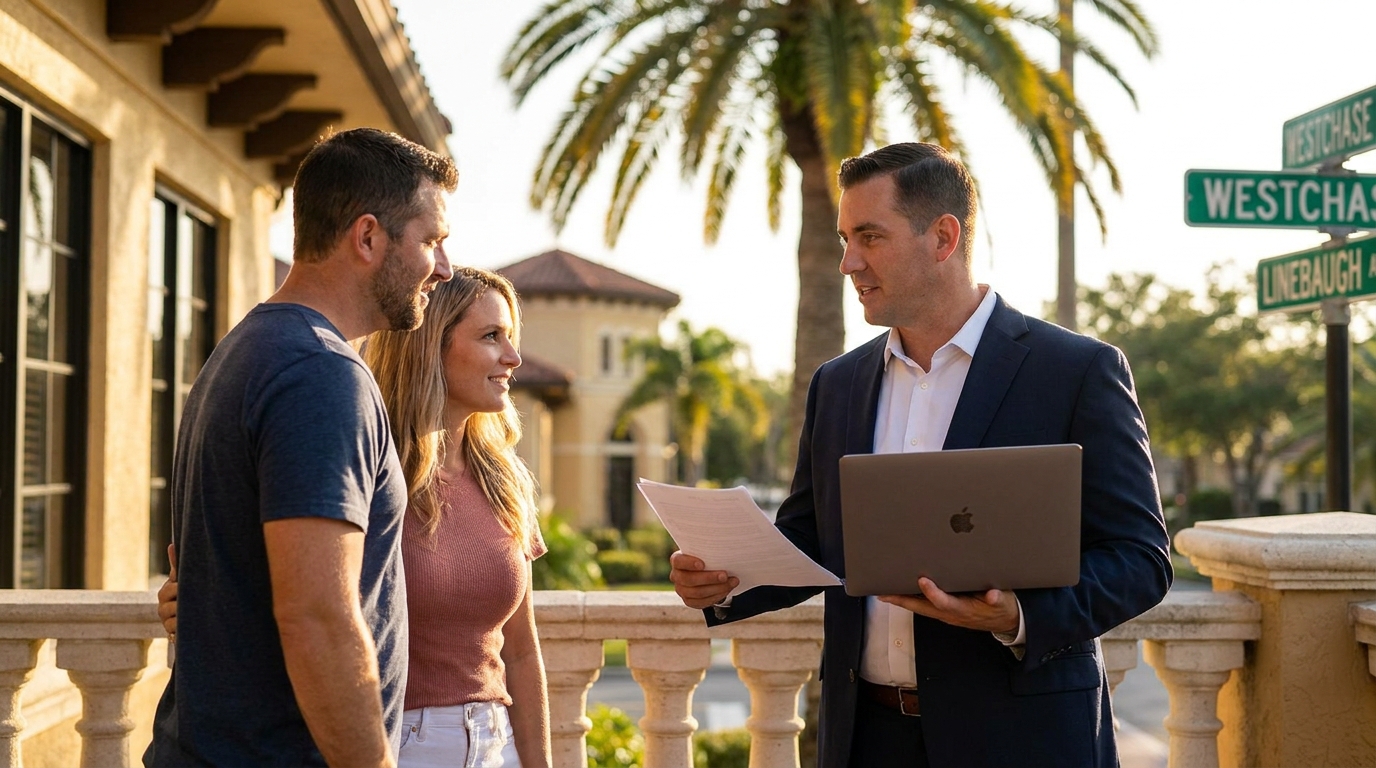
If you own a home in Westchase and you've been watching rates, you've probably asked the same question your neighbors are asking: who actually gets you the lowest refinance rate — a mortgage broker, a big national bank, or a local credit union? It's a fair question, and the honest answer isn't a single name. It's a decision framework that depends on your income, your existing accounts, and how complicated your file is.
Westchase is a specific kind of Tampa submarket. The housing stock skews toward 1990s and 2000s single-family homes and townhomes inside a deed-restricted community, with a healthy mix of W-2 professionals commuting toward the Westshore business district and self-employed owners running businesses from home. That mix matters, because the right refinance channel for a salaried professional on Linebaugh Avenue is often not the right channel for a contractor or a small-business owner two streets over.
Here's how to think about it.
The Three Lender Types Westchase Homeowners Actually Use
When people say "refinance lender," they usually mean one of three things:
- A mortgage broker — an independent, state-licensed intermediary who shops multiple wholesale lenders on your behalf.
- A direct bank — a national lender that funds loans with its own money and offers only its own programs.
- A local credit union — institutions that lend to members within their footprint.
All three operate in the same Tampa rate environment. As of mid-September 2026, broker-quoted 30-year fixed refinance rates in the Tampa market are running around 6.50%, 15-year fixed refinance rates around 5.75%, and cash-out refinance rates around 6.78%, according to current Tampa broker data. No channel is magically outside that band. What differs is how you get placed inside it.
Rate Range: Why the Channel Alone Doesn't Decide
This is the part most homeowners get wrong. They assume one lender type is structurally cheaper. It isn't.
A direct bank or credit union may quote within that same general range. A broker pulling from multiple wholesale lenders works inside that same window. Your rate is driven by your credit score, your loan-to-value ratio, your debt-to-income, the loan product, and any relationship discounts — not by the sign on the door.
Where the channel does matter is access. A broker can submit one file and have it priced by several wholesale investors. A direct bank prices it once, against its own guidelines, and that's the answer you get.
Closing Costs: Similar Ranges, Different Levers
Total closing costs in a Tampa refinance vary by lender and loan size but include a consistent set of third-party charges regardless of channel. Florida requires both owner's and lender's title insurance, which adds meaningfully to nearly every refinance. Appraisals are another standard cost across all channels.
The differences show up in the lender-fee line and the promo line:
- Some credit unions run competitive flat lender fees and have waived appraisal on qualifying loans, which can knock a meaningful amount off your cash to close.
- Large national banks may offer a modest rate reduction for existing checking or investment customers — a real but narrow benefit for relationship clients.
- Brokers in Tampa typically charge either a borrower-paid fee of roughly 0.5%–2% of the loan amount, or a lender-paid fee of roughly 1%–2.75% built into the rate, according to current Tampa market data. In many cases the borrower sees no separate out-of-pocket broker fee because compensation is lender-paid.
The lesson: get a written Loan Estimate from more than one source. The Loan Estimate is standardized under federal TRID rules, which makes apples-to-apples comparison straightforward — and it's the only way to see what the rate actually costs you.
Speed: Where Direct Lenders Often Win
Both channels typically close in 30 to 60 days. Direct banks and credit unions tend to run on the faster end because underwriting, conditions, and closing are handled in-house. If you already bank with them, they may also have your income and asset data on file, which trims days off the document-gathering phase.
Brokers can be a touch slower because the file moves between the broker, the wholesale lender, and third parties like the appraiser and title company. For a straightforward W-2 file with strong equity, that gap is small. For a complex file, the broker's flexibility usually outweighs the extra few days.
The Westchase Profile That Should Lean Toward a Broker
Brokers earn their keep on files that don't fit a single bank's underwriting box. In Westchase, that often looks like:
- Self-employed owners using bank-statement loan programs instead of tax returns.
- Real estate investors refinancing rentals elsewhere in Hillsborough or Pinellas County.
- Borrowers with strong assets but lumpy income — consultants, commissioned sales, 1099 contractors.
- Anyone who needs a non-QM or jumbo product, common in higher-priced pockets of Westchase.
- Cash-out refinances where the loan-to-value or use-of-funds story needs a specific lender's appetite.
The broker channel gives you access to conventional, FHA, VA, jumbo, non-QM, bank-statement, and cash-out programs in one submission. If one wholesale lender pushes back, the file can move sideways to another without restarting from scratch. One escrow professional who worked alongside Bay to Bay Lending on a difficult file wrote that having "a lender that truly cared and wanted the best for their client was the key to getting this one closed" — a sentiment that reflects what broker flexibility looks like in practice on complex Westchase profiles. This is the core argument for working with an independent Tampa mortgage broker like Bay to Bay Lending when your file has any wrinkles.
The Westchase Profile That May Do Well Direct
If you're a W-2 employee with a strong credit score, plenty of equity, and an existing checking or money market account at a local credit union or a national bank, the direct channel is worth a quote. Relationship discounts are real, fee waivers are real, and the process is genuinely simpler when the institution already knows you.
You should still get a second Loan Estimate from a broker for comparison — but don't be surprised if your existing bank lands within a few basis points of the wholesale market, especially after applying loyalty pricing.
Tampa-Specific Costs You Can't Avoid
A few line items are baked into any Tampa refinance, regardless of channel:
- Title insurance, both policies. Florida requires owner's and lender's coverage on every refinance.
- Florida documentary stamp tax on the new note. This is a state-level cost that shows up on every Florida mortgage transaction.
- Homeowners insurance and wind coverage. Not a closing cost, but if your premium has jumped since your original purchase — which is common across Tampa right now — your escrow analysis will reflect it, and that affects your new monthly payment whether you refinance through a broker or a bank.
It's worth lining up an insurance quote refresh before you start the refinance, ideally well ahead of hurricane season, so there are no surprises when the lender pulls your binder.
FAQ
Does a mortgage broker actually get lower rates than a bank in Tampa?
Sometimes, but not automatically. Brokers shop multiple wholesale lenders operating in the same general rate environment as banks. The advantage is access and placement flexibility, not a structurally lower rate sheet.
Will using a broker cost me more out of pocket?
Generally no. Broker compensation is typically lender-paid and embedded in the rate or fees, with borrower-paid options also available. You should still compare Loan Estimates side by side to see the true total cost.
I bank at a Tampa credit union. Should I just refinance there?
Get their quote — relationship pricing and appraisal waivers can be meaningful. Then get one outside quote so you know whether you're being rewarded for loyalty or quietly paying for convenience.
How long will a Westchase refinance take to close?
Plan for 30 to 60 days. Direct lenders often land on the shorter end; broker files can take slightly longer when multiple parties coordinate, especially on complex profiles.
How do I know if a Tampa mortgage broker or lender is legitimate?
All mortgage brokers and lenders serving Tampa must be licensed by the Florida Office of Financial Regulation and registered in the Nationwide Mortgage Licensing System. You can verify license status and check complaint history through OFR's public tools before you share any personal or financial information.
Is Bay to Bay Lending a broker or a direct lender, and does that affect my options?
Bay to Bay Lending operates as a mortgage broker, meaning the team shops your file across multiple wholesale lenders rather than funding the loan from a single in-house source. For Westchase borrowers, that means one application can generate competing offers from several investors — particularly valuable for self-employed profiles, jumbo loans, or cash-out scenarios that don't fit a single bank's standard box. Bay to Bay Lending holds a 4.6-star rating from 36 Google reviews as of April 2026, with reviewers consistently citing responsiveness, clear explanations, and success on complex files.
The Bottom Line for Westchase
There is no single "best" lender type for every Westchase homeowner. The best channel is the one that matches your file. Strong W-2 borrowers with existing local banking relationships should at least price out their own institution. Self-employed owners, investors, and anyone with a non-standard income picture will almost always be better served by a broker who can shop the file across multiple wholesale lenders in one pass.
Homeowners in Westchase who want this handled professionally — with multiple lenders shopped in a single submission and a clear side-by-side of the real numbers — can reach Bay to Bay Lending at https://baytobaylending.com/ or by phone at (813) 251-2700. The office is located at 326 South Hyde Park Avenue, Tampa, FL 33606.
"