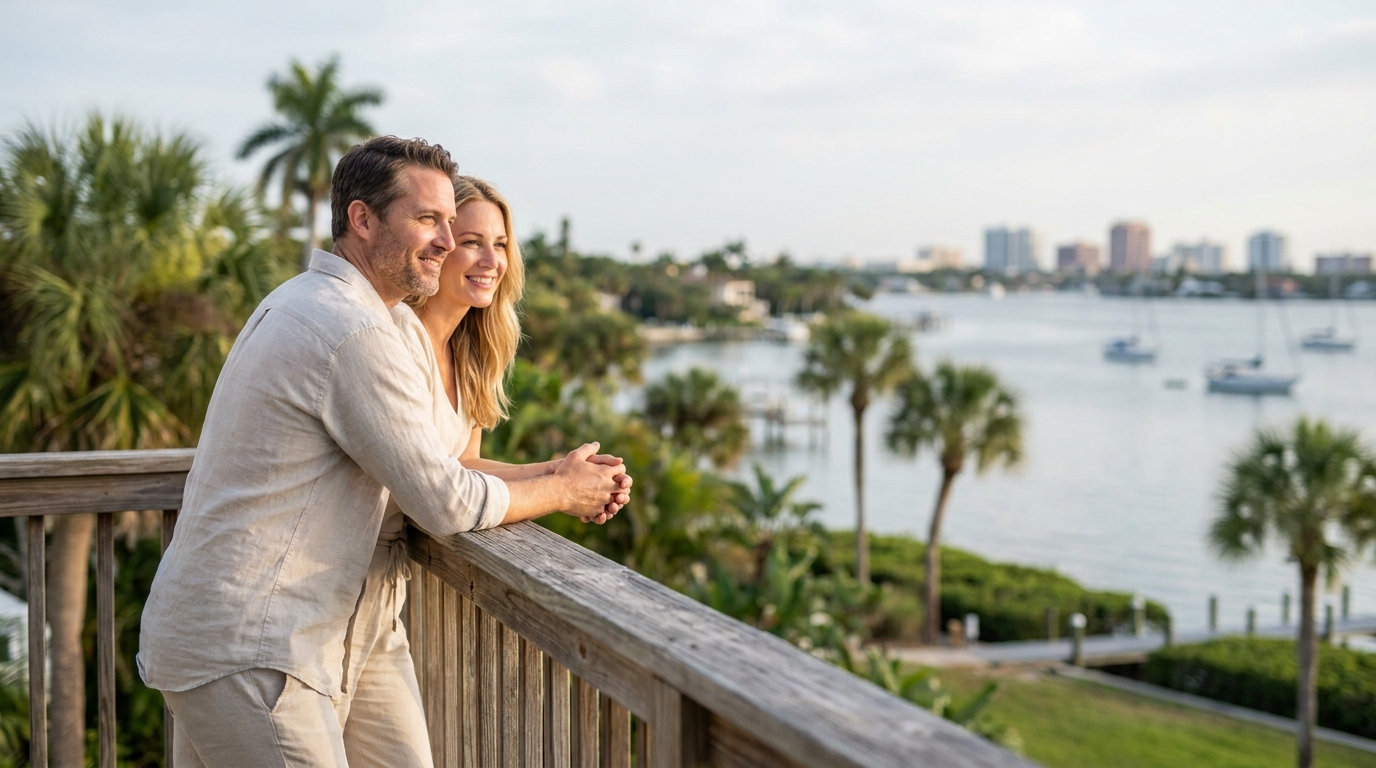
If you're trying to buy a home in Sarasota and the math on a 20% down payment isn't math-ing, you're not alone. Median prices along the Gulf Coast have stretched what "affordable" looks like, and even buyers with strong incomes are bumping up against the same wall: saving six figures in cash while rent keeps climbing. The good news? You don't actually need 20% down. You may not even need 5%. Several conventional and government-backed programs let qualified buyers put down as little as 3%, and they work in Sarasota's market more often than people assume.
Here's an honest, plain-English look at how 3% down mortgages work in Sarasota, who they fit, and what to watch for before you sign.
What Counts as a Low Down Payment Mortgage in Sarasota?
A low down payment mortgage is any home loan that requires less than the traditional 20% down. In Sarasota, the most common options buyers use are:
- Conventional 97 loans — 3% down, backed by Fannie Mae or Freddie Mac
- FHA loans — 3.5% down, backed by the Federal Housing Administration
- VA loans — 0% down, available to eligible veterans and active-duty service members
- USDA loans — 0% down, available in designated rural areas (parts of eastern Sarasota County qualify)
- Down payment assistance programs — Florida Housing offers second-mortgage and grant products that can stack with the loans above
Each of these has its own credit, income, and property rules. The 3% conventional option tends to get the least attention but often makes the most sense for Sarasota buyers with solid credit who don't qualify for VA or USDA.
How the 3% Down Conventional Mortgage Actually Works
The Conventional 97 program (the "97" refers to a 97% loan-to-value ratio) lets you finance 97% of the purchase price. On a $450,000 home — roughly the entry point for many Sarasota neighborhoods east of I-75 — that's $13,500 down instead of $90,000. The difference is life-changing for most first-time buyers.
To qualify, you generally need:
- A credit score of 620 or higher (most lenders prefer 680+)
- A debt-to-income ratio under 45%
- At least one borrower who hasn't owned a primary residence in the past three years (for the first-time buyer version)
- Documented income and steady employment
- The property as your primary residence
Private mortgage insurance (PMI) is required, but here's what many buyers miss: PMI on a conventional 3% down loan is often cheaper than the mortgage insurance on an FHA loan, and it drops off automatically once you reach 22% equity. With Sarasota's appreciation patterns, that milestone can arrive faster than you'd expect.
FHA vs Conventional 3% Down: Which Fits Sarasota Buyers?
This is the comparison we walk through with most first-time buyers. Both let you in with minimal down payment loans, but they behave differently over the life of the loan.
FHA loans favor:
- Buyers with credit scores between 580 and 660
- Buyers with higher debt-to-income ratios
- Buyers purchasing condos in FHA-approved buildings (relevant if you're looking downtown or on the keys)
Conventional 3% loans favor:
- Buyers with credit scores above 680
- Buyers who want PMI to eventually disappear
- Buyers purchasing in non-FHA-approved condo developments — which includes a meaningful share of older buildings on Lido Key, Siesta Key, and Longboat Key
Condo financing is a real consideration in Sarasota. Many waterfront buildings aren't on FHA's approved list, which can quietly eliminate that route before you even make an offer. A conventional 3% down loan often becomes the workable path in those cases.
Florida-Specific Costs Sarasota Buyers Should Plan For
Down payment is only part of the cash you'll need at closing. Florida has its own line items that catch out-of-state buyers off guard:
- Documentary stamp tax on the mortgage (charged by the state of Florida)
- Intangible tax on the mortgage amount
- Title insurance — Florida uses a promulgated rate structure
- Homeowners insurance — and in Sarasota, this means wind/hurricane coverage, which has gotten significantly more expensive across the Gulf Coast
- Flood insurance, if your home sits in a FEMA-designated flood zone (much of Sarasota's barrier islands and parts of the mainland near Phillippi Creek and Hudson Bayou do)
If you're buying in a flood zone or coastal wind zone, your monthly payment will include insurance escrows that look very different from inland Florida or the rest of the country. We always recommend getting an insurance quote before you finalize an offer in Sarasota — it can shift your buying power by tens of thousands of dollars.
Timing Your Sarasota Home Purchase
Sarasota's market has rhythms worth knowing. Snowbird months from January through March bring the most competition, especially for condos and homes west of the Trail. Summer — particularly July through September, the heart of hurricane season — tends to be quieter, which can mean more negotiating room. If you're using a low down payment loan, having a less competitive offer environment matters, because cash buyers often dominate the peak season.
It also pays to lock your insurance binder before any named storm enters the Gulf. Carriers routinely freeze new policies once a storm is in the cone, which can stall or kill a closing.
How to Position Yourself for a 3% Down Approval
A few practical moves that help in our experience:
- Get pre-approved, not pre-qualified. Sarasota sellers and listing agents take pre-approvals seriously and often discount pre-qualifications.
- Don't open new credit lines. No new cars, no new store cards — keep your credit profile boring until you close.
- Document your down payment source. Underwriters will ask. Gift funds are allowed on most 3% down programs, but they need a paper trail.
- Stack down payment assistance if you qualify. Florida Housing's programs can cover part of your 3% — meaning you may close with very little out of pocket.
- Work with a broker who shops multiple investors. Rates and PMI pricing on 3% down loans vary more than on 20% down loans, and the right pairing can save you real money monthly.
Frequently Asked Questions
Can I use a 3% down mortgage for a condo in Sarasota?
Yes, but the building has to be warrantable under conventional guidelines. Many older waterfront condos on Siesta Key or Longboat Key require non-warrantable or portfolio loan products instead, which usually need more down.
Is PMI a deal-breaker on a 3% down loan?
Not usually. On a $450,000 Sarasota home, PMI typically runs $100–$250 per month depending on credit, and it falls off once you reach 22% equity. Most buyers find it more affordable than waiting years to save 20%.
What credit score do I need for a 3% down mortgage in Sarasota?
620 is the floor for most conventional 3% programs, but you'll see meaningfully better pricing at 700+. FHA goes lower — sometimes to 580 — if your score isn't there yet.
Can I combine a 3% down loan with down payment assistance?
Often yes. Florida Housing's programs are designed to layer with conventional and FHA loans, though they have income limits and require homebuyer education.
Working With a Local Broker
Low down payment loans are where having someone in your corner who understands both the loan products and the Sarasota market really matters. Bay to Bay Lending works with buyers across the Gulf Coast on 3% down conventional, FHA, VA, and USDA loans, and the team's reviews reflect what tends to make these transactions go smoothly — clear communication, quick responses, and a willingness to run multiple scenarios. As one recent reviewer put it, the team "makes complicated topics easy to understand." That matters when you're navigating PMI, insurance escrows, and condo warrantability all at once.
If you're weighing your options for Sarasota home financing and want a straightforward conversation about what you actually qualify for, you can reach Bay to Bay Lending at https://baytobaylending.com/. They'll walk you through the numbers without pressure and help you figure out whether 3% down, 5% down, or something else makes the most sense for your situation.
"