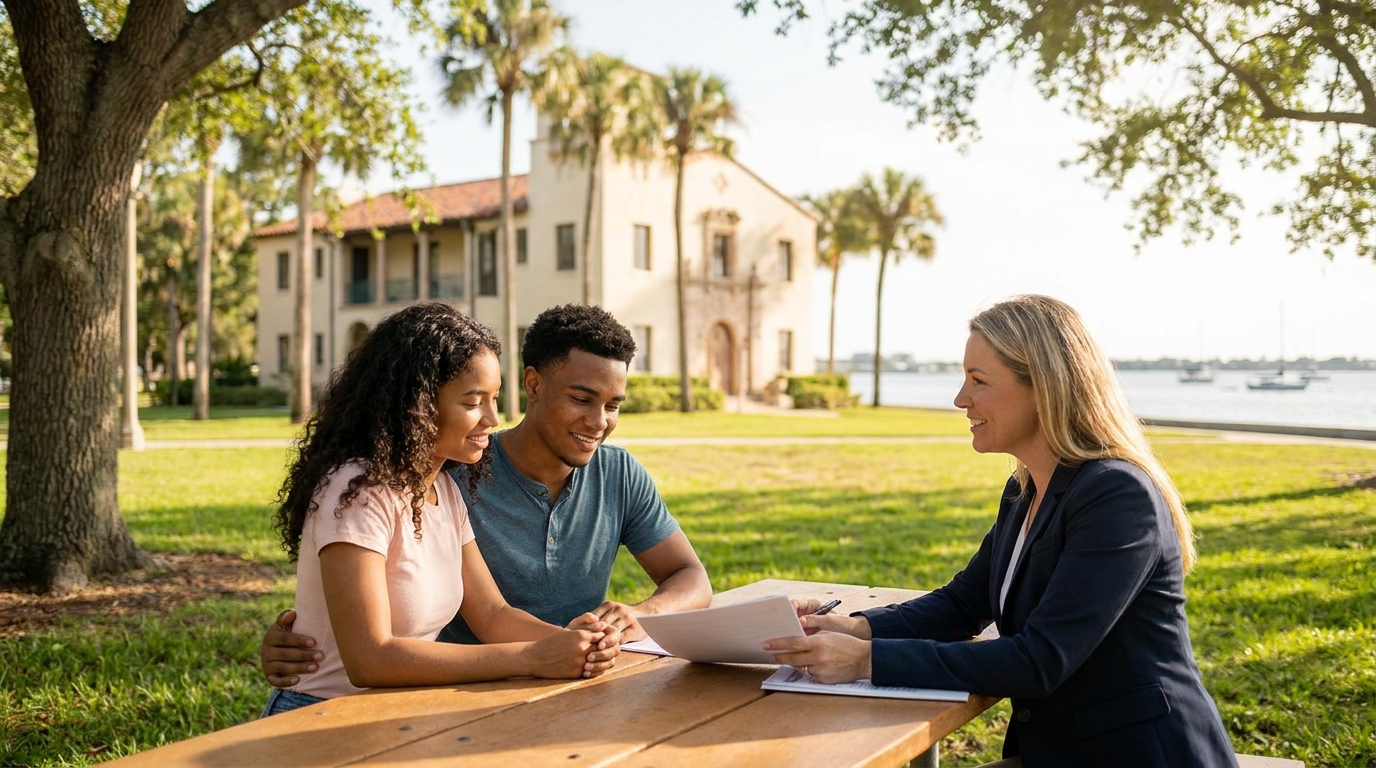
If you're trying to buy your first home in St Petersburg, you've probably noticed the math is tight. Insurance is up, prices have held steady in most neighborhoods, and the cash needed to close keeps creeping higher. The good news: there's real money on the table for first-time buyers here — you just have to know where to look and what you'll need to qualify.
This guide walks through the main first time home buyer programs in St Petersburg, who they're for, and the steps that trip people up before closing.
What Counts as a First-Time Home Buyer in St Petersburg
The definition is more generous than most people assume. You're considered a first-time buyer if you've had no ownership interest in a residential property in the past three years. That means if you owned a home years ago, sold it, and have been renting since, you may still qualify.
This three-year rule is the standard used by both the City of St. Petersburg and Florida Housing Finance Corporation programs, and it's also accepted by most federal loan products you'd pair the assistance with.
There are also notable exceptions. Qualified veterans under specific programs may be exempt from the three-year rule entirely. Buyers purchasing in federally designated targeted census tracts or redevelopment areas can also bypass it. Displaced homemakers and single parents whose prior ownership was only as a joint owner with a former spouse may still qualify as first-time buyers.
The City of St. Petersburg Purchase Assistance Program
This is the headline program for buyers inside city limits. The City of St. Petersburg offers a Purchase Assistance Program that provides up to $75,000 to income-eligible first-time homebuyers purchasing within city limits.
The assistance comes as a subordinate mortgage secured by a recorded lien against the property. The assistance is secured by a recorded mortgage or lien, and is subject to recapture if you sell, refinance, or cease to occupy the home as your primary residence during the required occupancy period.
How the Forgiveness Works
Assistance is tied to continued owner-occupancy as your primary residence. If you sell, refinance, or cease to occupy the home as your primary residence during the required period, the assistance may become due and payable. The specific forgiveness timeline depends on the funding source and your income tier, so confirm the current terms with the City of St. Petersburg Housing and Community Development office before closing.
Income Limits to Know
Income limits are tied to Pinellas County Area Median Income. Depending on the specific funding source, program eligibility extends to households earning up to 80% or 120% AMI. HUD updates these figures annually, so confirm the current thresholds before you build your budget around them.
Other Requirements You Have to Meet
The city program isn't a free-for-all. There are several boxes you have to check before closing:
- Your own money in the deal. You must contribute at least 1% of the purchase price from your own funds.
- Homebuyer education. You have to complete an 8-hour HUD-approved homebuyer education course before closing. This isn't a formality — the certificate goes in your file.
- Primary residence. The home has to be your primary residence. Rental or investment use is prohibited.
- Property location. The property must be inside St. Petersburg city limits, verified through the Pinellas County Property Appraiser with a tax district designation of 'SP'.
- Minimum credit score. Florida Housing Finance Corporation-backed programs require a minimum credit score of approximately 640.
- Mortgage type. You must qualify for a 30-year fixed-rate mortgage — FHA, VA, USDA, or conventional — from an approved lender. Adjustable-rate and subprime loans are generally prohibited.
- Lead clearance for older homes. For properties built before 1978, the seller must provide a Lead Clearance certificate confirming the home is free of lead-based paint hazards, as required by HUD's Lead Safe Housing Rule.
- Required documentation. Expect to provide a government-issued photo ID, proof of citizenship or permanent resident status, mortgage loan application forms, a contract for sale and purchase, and a licensed home inspection report.
The older housing stock in neighborhoods near downtown, Old Northeast, and parts of the southside can present roof, electrical, or plumbing issues that may require attention. Plan for that during your offer negotiations.
What About Pinellas County's Program?
Pinellas County operates its own Down Payment Assistance Program. On paper, that sounds like a second option for St Petersburg buyers — but it isn't.
The county program explicitly directs buyers in St. Petersburg, Clearwater, and Largo to those cities' own programs. So if you're buying in St. Pete, your path is the city program, not the county one.
County Program Terms (for Context)
If you're buying just outside St Petersburg in an eligible part of unincorporated Pinellas, confirm the county program's specific terms, asset limits, purchase price caps, forgiveness timeline, and counseling requirements directly with Pinellas County, as these details are subject to change.
How to Sequence Your Application
The biggest mistake first-time buyers make is treating assistance as something you tack on after going under contract. It doesn't work that way. Here's the order that actually moves smoothly:
- Get pre-approved with a lender who works with these programs. Not every lender does. The subordinate mortgage paperwork, layered underwriting, and timing all require a lender who has closed these loans before.
- Sign up for the 8-hour HUD-approved course early. Slots fill up, and you can't close without the certificate.
- Confirm program funds are available. Both city and county programs are funded through federal HOME, CDBG, and Florida SHIP dollars. When funds run out for the fiscal year, applications get wait-listed.
- Shop in eligible neighborhoods. Confirm property location in the St. Petersburg tax district before making an offer, especially if you're near city boundaries.
- Build inspection time into your contract. Any required repairs need to happen before closing, which usually means a longer contract period than a cash buyer would offer.
First Time Home Buyer Grants in St Petersburg: FAQs
Are these programs grants or loans?
Technically they're subordinate mortgages, not grants. But if you meet the occupancy and primary-residence requirements through the forgiveness period, the loan is forgiven, which functions like a grant. The specific forgiveness timeline varies by funding source and income tier.
Can I combine city assistance with an FHA or conventional loan?
Yes. The city Purchase Assistance Program is designed to layer on top of a first mortgage. Your lender structures it as a subordinate lien recorded against the property.
What happens if I sell the home before forgiveness?
Selling, transferring the property, refinancing, or moving out as your primary residence are events that can trigger repayment of the assistance. The exact amount owed depends on where you are in the forgiveness schedule and the terms of your specific funding source.
Do I have to be a U.S. citizen?
Programs require proof of citizenship or permanent resident status under federal HOME and CDBG rules. Your lender or the city's Housing and Community Development office can confirm the exact documentation requirements for your situation.
How long does the application process take?
Plan for the assistance approval to add several weeks to a typical closing timeline. Between course completion, required inspections, repair verification, and the city's underwriting review, Plan for the assistance approval to add meaningful time to a typical closing timeline, given the course completion, required inspections, repair verification, and the city's underwriting review.
What credit score do I need to qualify?
Florida Housing Finance Corporation-backed first-time homebuyer and down-payment assistance programs require a minimum credit score of approximately 640. Your first mortgage lender may have additional credit requirements depending on loan type — FHA, VA, USDA, and conventional each carry their own standards.
Can I use these programs if I previously owned a home with a former spouse?
Possibly. Displaced homemakers and single parents whose prior ownership was only as a joint owner with a former spouse may still qualify as first-time homebuyers under program rules. This is one of the most commonly overlooked exceptions — if your situation fits, confirm eligibility directly with the city's Housing and Community Development office.
Where to Go From Here
First-time buyer assistance in St Petersburg is genuinely useful — sometimes the difference between renting another year and closing on a home — but the programs reward buyers who plan ahead. Income documentation, the 8-hour course, the 1% contribution, and a lender who knows the subordinate-mortgage process all need to line up.
Bay to Bay Lending works with first-time buyers throughout St Petersburg, with customers highlighting clear communication and responsiveness throughout complex closings.
If you'd like help mapping out which program fits your income, neighborhood, and loan type, Bay to Bay Lending works with first-time buyers throughout St Petersburg and can walk you through pre-approval alongside the city assistance paperwork. You can reach them at https://baytobaylending.com/ to talk through your situation.
"